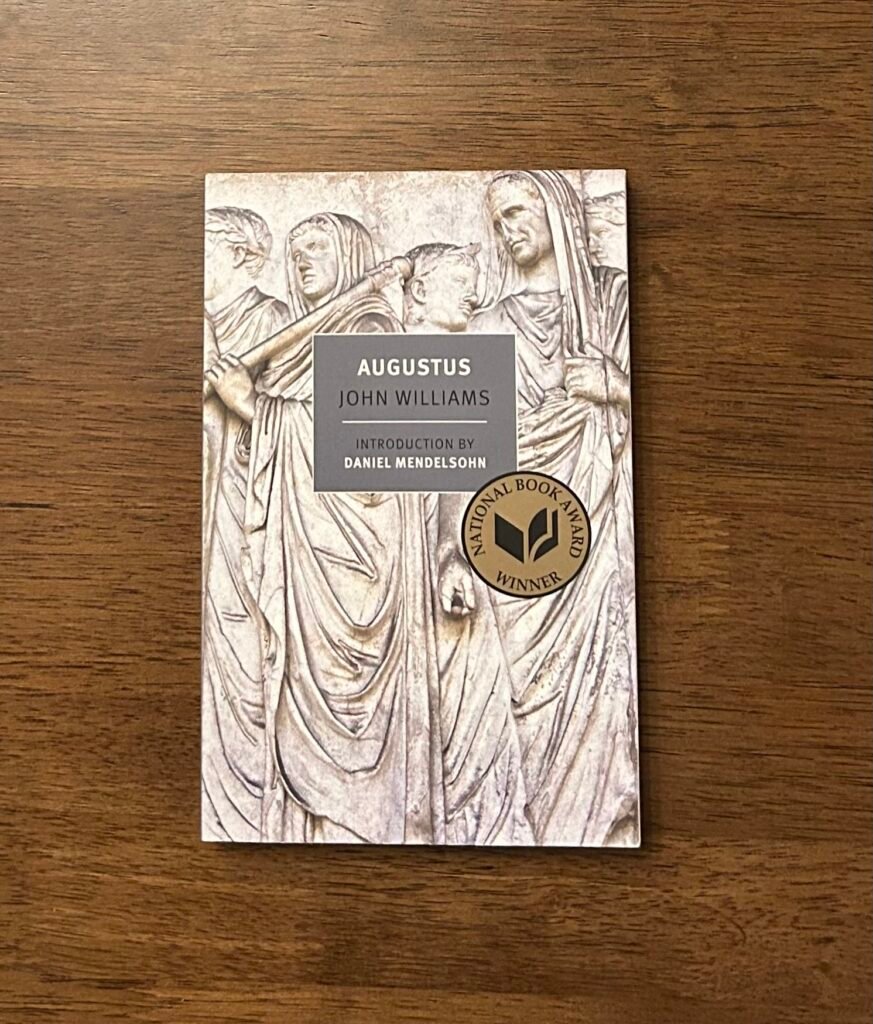
John Williams’ last novel breaks from his usual setting of the lonely American frontier in the mid-to-late 1800s for ancient Rome. Rather than a traditional novel it’s written as a collection of letters, diaries, dialogues, and senatorial proceedings that follow the life of Caesar Augustus. In the first part, we see Augustus rise to power and he learns how to gain power by appealing to the people rather than the senate, form alliances to slowly decrease his political opponents, and come to be the sole ruler of the Roman Empire. The second part moves away from his battles and political schemes to focus on the personal aspects of leadership and “soft politics” of lineage and leadership. Here we also meet his daughter, Julia, who he loves but it bound by her duties as daughter of the Emperor and her failings led her to exile on an island as she writes her diaries. As Augustus struggles to maintain power and provide works for the empire he becomes deeply isolated both by the extent of his duties and by the scheming of others. The short third part sees Augustus in his later days, writing to Nicolaus of Damascus about the long-term value of his efforts, the progress of history, and the personal cost of duty.
But make no mistake that this is a John Williams novel. A somewhat feckless young man is faced with a choice between an easy life and a great challenge. Taking the leap leads to great challenges and some accomplishments but the cost of greatness is rarely worth it. Whether the choice was to drop out of school for an Emersonian buffalo hunt, to leave the family farm to pursue a literature degree, or to turn away from a life of comfort to unite and lead an empire, the choices are driven by some ill-defined interest and naive idealism (although the stakes are different). The challenges may be physical (buffalo hunting, battles) or relational (particularly power struggles either in academia or Roman politics). The nearly unified ending of a John Williams novel is that pursing higher goals is hardly worthwhile if they are pursued at the expense of all relationships and happiness–buffalo hides may drop in value, great publications may never come to fruition, or the empire may fall into the hands of someone more focused on themself.
As Julia asks:
“Father,” I asked, “has it been worth it? Your authority, this Rome that you have saved, this Rome that you have built? Has it been worth all that you have had to do?”
My father looked at me for a long time, and then he looked away. “I must believe that it has,” he said. “We both must believe that it has.”