Blog

  • Just Read: “The Enchanted April” (von Arnim) 

    In the same category as “A Room with a View”–some stuffy English ladies go to Italy on vacation but end up dropping their formality in the lush, blooming gardens and find love. 

    Here, four ladies of different ages and means (but essentially all strangers) pool their money to rent a Tuscan villa for a month. Nearly nothing is coordinated ahead of time which leads to lengthy conflict over personal spaces and shared costs. Two of the women are particularly thorny: Lady Caroline just wants to be left alone and treated normally and Mrs Fisher just wants it to be the Victorian era again. Lotty holds things together with her enthusiasm while she and Rose worry about their unhappy marriages. The arrival of men, after much foreboding, shakes up the entire situation.  

    This is a lighthearted, happy-ending story with low stakes drama. The writing is old fashioned in a good way as the book takes its time and doesn’t try to force anything. Not the greatest thing ever written, but a nice spring read while everything was blooming. 

  • 20260426 Sourdough Sunday

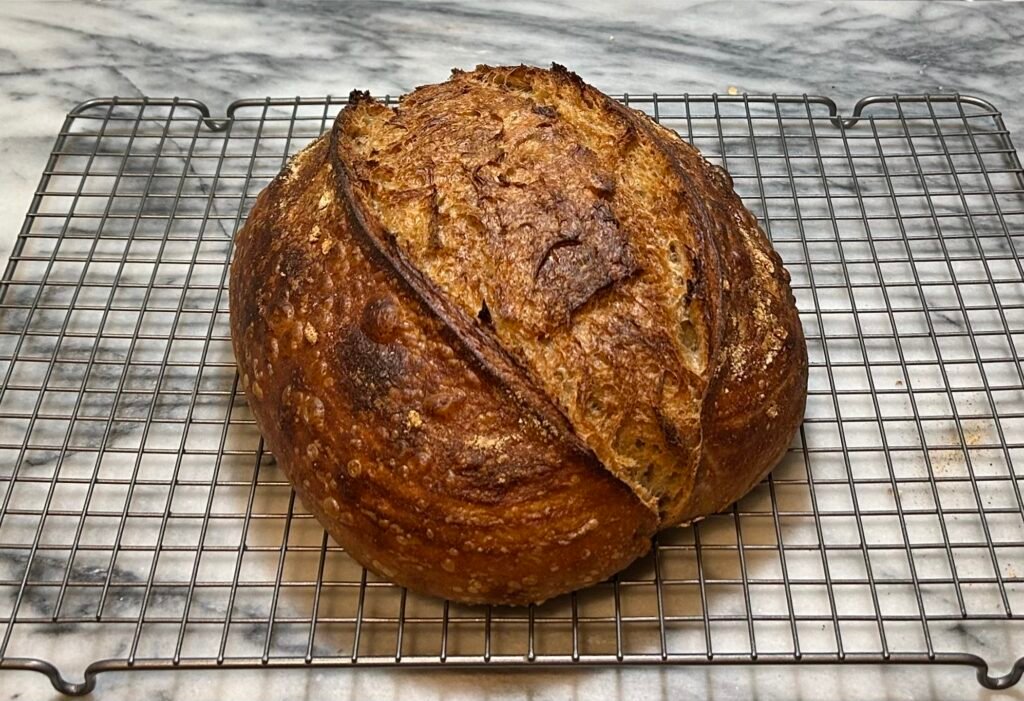
    A “finishing the bag of flour” amount of whole wheat (~40%) with a long fermentation which generated some nice blisters.

  • 20260412 Sourdough Sunday

    After buying more whole wheat flour instead of bread flour I’ll be switching to a 50% whole wheat loaf for a while (or at least until I slow down on baking in May/June).

  • Just Read: “Sisters in Yellow” (Kawakami) 

    Mieko Kawakami has a style–a lonely, working woman struggles to stay afloat amid financial pressures and expectations about appearance/behavior/marriage/etc. Most of the books (“Heaven” is the outlier) have a consuming (but unreliable?) narrator. There’s an honesty about poverty and expectations in modern(ish) Japan like Tsushima but otherwise Kawakami nearly stands on her own. Maybe too much? It could be that there is a cultural barrier here but many of the topics and conversations felt a bit expected. Maybe this is a western lens applied to a work that is trying to make a point about the tenuous nature of the hospitality industry and how much appearance and tolerance of harassment are necessary to secure a small income. Maybe this point was already made in “Breasts and Eggs.” Our protagonist is lonely and motivated by the determination to work hard to the point of exhaustion due to a tenuous employment while neglecting any sort of leisure or social life, similar to “All the Lovers in the Night.” 

    This novel follows Hana, basically a runaway who takes a job at a bar and moves in with one of her mother’s strange friend, Kimiko, who had helped her when she was younger. She finds some friends who join her. When that’s no longer viable, she turns to petty crime and some Yakuza-associated schemes to get by. Things fall apart as always and a regular job is necessary which takes us to 2020. 

    Kawakami writes with style and control, this feels like her most mature novel but, having read the others, I wonder if she’s searching for more to say. 

  • 20260405 Sourdough Sunday

    A jalapeno cheddar loaf for an Easter potluck. Several people don’t each gluten or dairy–more for me!

  • Just Read: “Jesus and John Wayne” (Du Mez)

    Du Mez writes a history of how Evangelical Christianity has interfaced with politics and become obsessed with (non-Biblical) displays of masculinity. 

    This book presents the Evangelical movement, particularly as it developed from the 1980s as more of a cultural movement linked to certain media consumption as the defining feature of the “Evangelical” voting demographic to explain how a religion-affiliated political movement came to define American Christianity. Largely, Du Mez is focused on voting patterns that claim to be religious but focus on gender roles and conservative politics above all else. 

    The book looks at a few major movements: Evangelicalism from the 1920s through the 1960’s (finding John Wayne), the Cold War (Oliver North), and the war on terror through the modern era (“spritiaul warriors” and sex scandals galore). The main takeaway is the extended long-game that’s been played between conservative Evangelicals despite different movements rising to power across the decades. When there isn’t a war, the movement has been concerned with gender and whether American men are masculine enough. 

    A historical argument is being made which leads to some one-sided exploration of how focusing on traditional gender roles led to scandals over predatory pastors which should be a consideration when reading this; this isn’t meant to be a non-thesis look at the Evangelical movement. 

    If anything is seriously missing from this work it’s higher education. The Falwell’s certain make their appearances, as does homeschooling, but there is little to be said about the rise of institutions like Liberty University and the many loosely accredited Christian colleges. 

    Listen: “Jesus and John Wayne” (googly eyes, Joy Oladokun, August Ponthier), “Jesus and John Wayne” (Gaither Vocal Band) 

  • 20260322 Sourdough Sunday

    An oatmeal loaf with the whole wheat content pushed to 50% which behaved surprisingly well if it was a bit slow to rise.

  • Just Read: “The Brothers Karamazov” (Dostoevsky, tsl. Katz) 

    The greatest novel ever written? Hardly the greatest novel that Dostoevsky wrote. 

    In many ways the 900 page length was too short as many of his ideas from previous works are represented here in somewhat shortened form and the plot is substantial. What is relatively missing are the characters who feel somewhat underdeveloped. Alyosha is not quite a Prince Mishkin, Ivan is no Stepan (and really barely present), and Dmitri is neither Raskolnikov or Rogozhin but the brothers all feel quite similar to characters in earlier works with a bit less development. 

    This is not to say that it’s bad as it’s deserved its place in the cannon of Russian literature. However, after reading the rest of Dostoevsky’s major works, this just feels like many of the ideas are jammed into one novel that doesn’t develop them as well as the others independently. Along with the slightly flat characters, this novel just feels a little too short to cover everything. 

    This completes my reading of Dostoevsky’s majors works and leaves me with “Poor Folk” and “The Gambler” among other notable works. My favorites among these remain Crime and Punishment (a nearly perfect novel with a lot of psychological insight but few ideas) and The Idiot (a novel of ideas and one of the clearest examples of Dostoevsky’s later thinking, particularly about Christianity). 

  • 20260308 and 202060315 Sourdough Sunday and “pi day” pie

    Last weeks with another 100% white flour loaf that was quite easy to manage but a little slow to rise.

    Back to the oatmeal loaf which has always managed to give good results without being too difficult to work.

    … and a pecan pie for “pi day” (a day late)

  • Just Read: “Flesh” (Szalay)

    I’m biased from knowing a Szalay or two and seeing that it won a Booker prize I decided to pick it up.

    It’s…fine? A novel about a man who has no idea what he wants beyond survival across many periods of his life. Written in some Hemingway meets Houellebecq meets “Saltburn” way, it doesn’t quite feel realized.

    Maybe it’s Houellebecq more a more mass-market audience? There’s plenty to be uncomfortable with but it lacks much substance that the creepy old man Michel provides plenty of. In fact, this seems like an odd choice for a Booker which I tend to associate with ambitious writing (often too much for me). It’s fine.

    Kudos to whomever at Scribner handled the marketing because it seems to hit on so many timely topics of (toxic?) masculinity, trauma, dissociation, etc in a way that was made to seem to relevant that even Dua Lipa couldn’t resist. But it just didn’t seem to add much to the conversation that was needed in 2025? Who knows