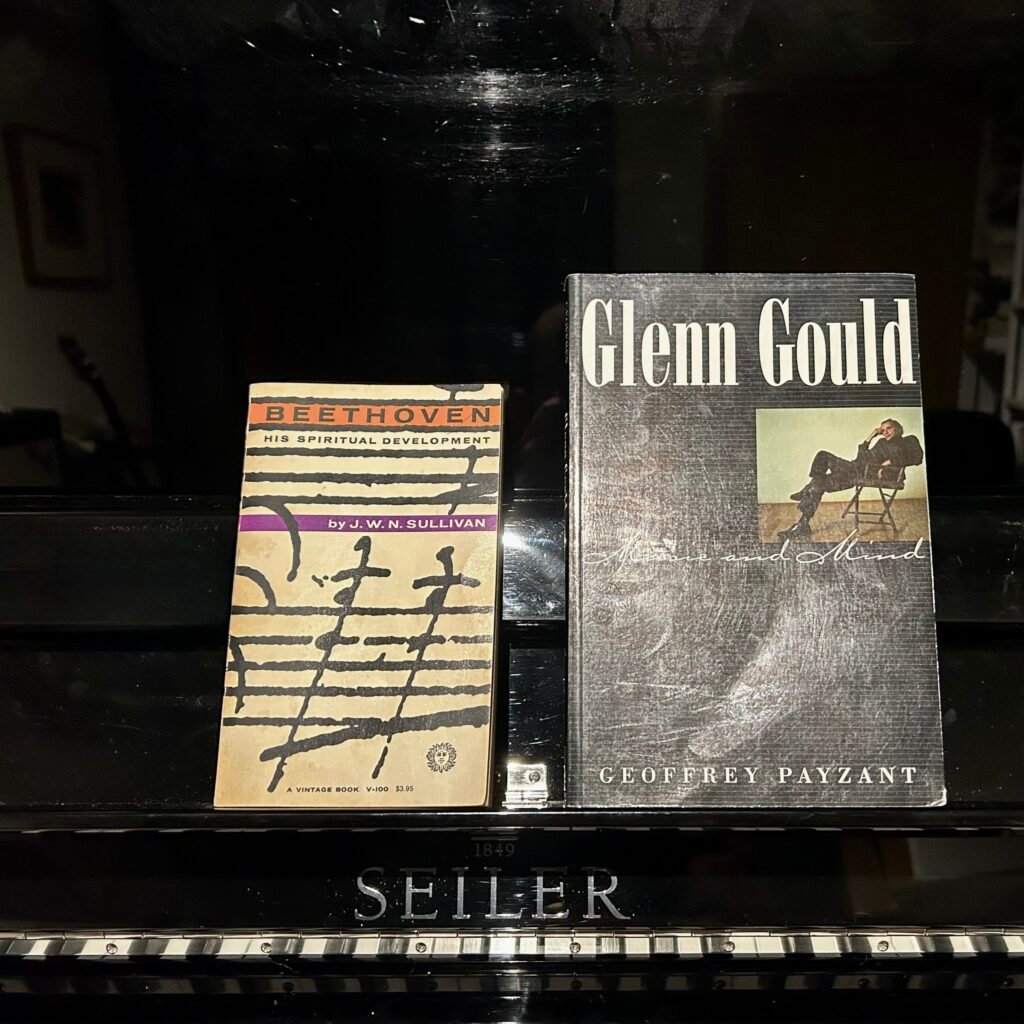
These are two classic biographies of the Canadian pianist Glenn Gould and Beethoven that focus on the intellectual/musical development related to their artistic output.
Pyzant’s biography of Glenn Gould contains little of the standard biographical detail but rather focuses on the writing and interview output of Gould in order to present his ideas. There are descriptions of Gould’s approach to repertoire, instrumentation, musical recordings (vs live performance and in terms of editorial splicing), and the essence of sound from the piano. Effectively, the ethos of Gould is summed up in ~150 pages.
This book is quite an accomplishment considering how unorthodox Gould was. It does no disservice toward how revolutionary Gould’s opinions were or how rigorously they were developed. In fact, this was so successful that it’s affected how I hear the piano as a percussion instrument (certainly a bit more than Mann’s idea of purity of harmony through a lack of sustain).
The Beethoven biography that Sullivan writes, on the other hand, is a work focused much more on how the authors ideas of how Beethoven’s suffering contributed to his musical development. While the compositions certainly developed in a few stages and his life was tumultuous as his fame increased and health decreased, this all feels little too narrativized. Sullivan wants us to believe that Beethoven, more than any other composer wrote music directly corresponding to his inner world and this is the reason for his greatness. This remains a somewhat popular opinion, but such simple yet encompassing claims rarely almost never capture the entire picture. In fact, this reads a bit like an artifact of its time and Beethoven’s influence on early modernism (through Strauss, early Schoenberg).
In trying to show the emotional depth of Beethoven’s music, Sullivan accomplishes what he criticized: imposing a “programmatic” sense of narrative and meaning to almost entirely instrumental music.
Leave a Reply