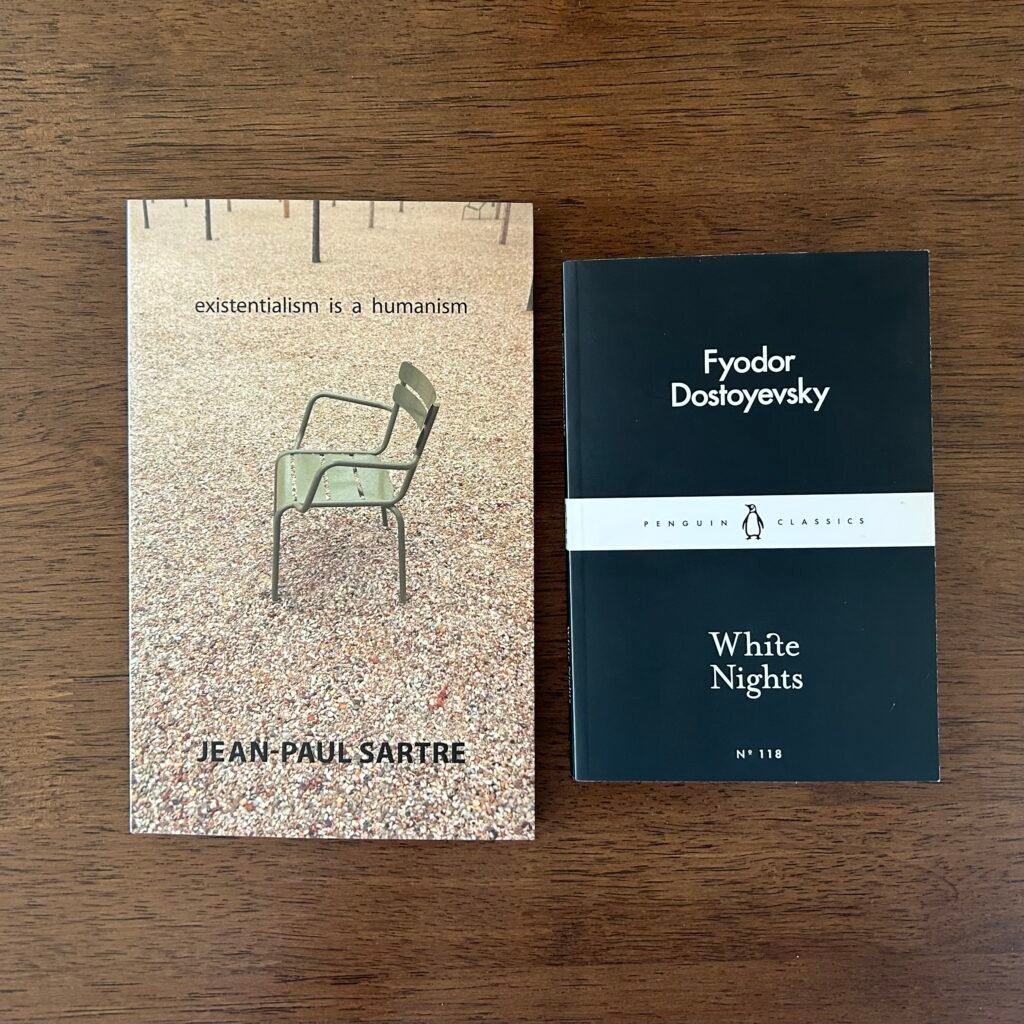
Based on many popular responses to “White Nights,” misunderstanding existentialism remains as common as it was when Satre delivered his lecture “Existentialism is a Humanism.”
“White Nights” is often discussed as a novella about loneliness and the redemptive power of love to wake a person from complacence. (Or about how the good guy ends up alone, to some). But really this is a story of an unnamed man wasting away in sad conditions while distracting himself with his studies. He expects that the perfect woman will appear for him and she does–only she’s waiting on the return of a man she intends to marry. The narrator expects things to go his way as if their relationship is fated to occur. But, having spent all of his time dreaming rather than living, his idealism sets him up for disappointment and stagnation.
Satre here explains to a general audience that the essence of existentialism is that “existence precedes essence,” or that things happen and then we must give meaning to them. He posits that we are burdened by choice but to avoid choice (or action) is to avoid reality. While he placed Dostoyevsky as a “Christian existentialist” (maybe so with his later works, e.g. “The Idiot”) Dostoyevsky is secular in “White Nights” where the narrator is unable to create the life he wants because he is overcome with inaction and the desire to avoid choice by “living” only through his studies that require limited choice or risk.
Both works are existential calls to action denying that reflecting on all that happens and everything wrong with the world will get us anywhere.
Leave a Reply