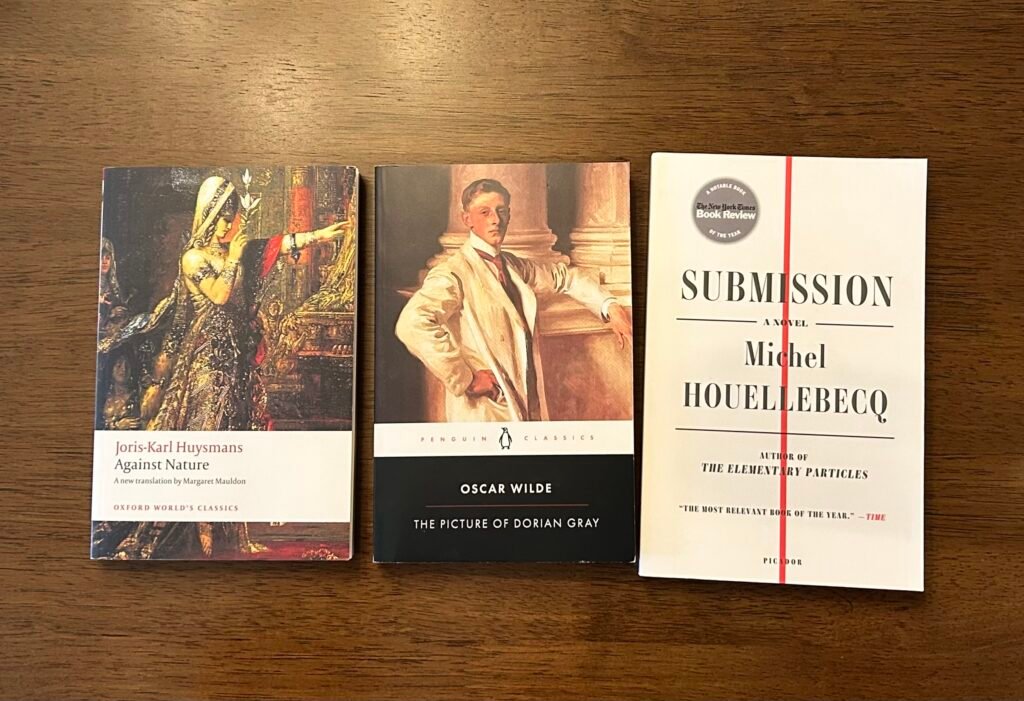
I have, for maybe ten years, wanted to read Huysmans’ “Against Nature” (À Rebours) since seeing it mentioned as a footnote of “The Picture of Dorian Gray.” This is considered to be the poisonous French novel that captivated Dorian and it clearly influenced Wilde’s writing, which seems quite clear.
Huysmans writes of an ailing heir, Des Esseintes, at the biological end of the family tree that was too interconnected. Years of hedonistic living and escorts have left him in poor health so he resolves to move into the country to live a solitary life of intellectual beauty. Chapters here serve mostly to display Des Essientes’s cultured tastes on such topics as Roman literature, interior decoration, jewels, plainchant, liqueurs, painting (including the Moreau on the cover), and perfume. These fixations exist in contrast to what Des Essiente feels is cultural decline where nothing of substance in being produced and the world is becoming fixated with industrial modernism (American, nonetheless). Unfortunately, the high arts offer no escape from Man’s necessarily social being.
This exists in the French tradition of brilliant novels that are terrible to read. This is tedious, with most of the interest happening in the introduction and at the end (maybe that’s the point). Huysmans posits that living through the senses is no replacement for living as social beings, even if that’s generally unpleasant.
I re-read Dorian Gray after the Huysmans since it had been a while. For some reason I thought that this novel was clunkier than it actually is and was pleasantly surprised at how much I still enjoyed it (maybe a little more at being able to recognize the Huysmans references).
Houellebecq writes of a Huysmans scholar (with plenty of references to À Rebours) working and existing as France elects an Islamic government through a compromise with the Left. Our protagonist, the nearly nameless François, a lonely professor disengaged from the world and mostly fixated on wine, cigarettes, and younger women (a Houellebecq novel, after all) is trying to avoid any issues while in the autumn of his intellectual life but must contend with the new government wanting to control higher education, putting him out of a job unless he converts.
Like Huysmans, Houellebecq writes a work of cultural pessimism about a life that is chiefly composed of materialism and bureaucracy, with a few carnal delights mixed in to make life bearable. Despite being considered a luminary on the Decadent period, François mostly craves connection and some higher sense of meaning in a culture that no longer emphasizes such things beyond a personal brand. His chief conflict is between his general dislike of organized religion and his desire to age with a partner (even through an arranged marriage). Largely a cultural critique of a modern Europe that has nothing to stand for and would be unable to resist a modern equivalent Ottoman invasion.
A bit of a tired rehashing of Houellebecq’s previous writing, a sub-par Houellebecq is still alright.
Leave a Reply