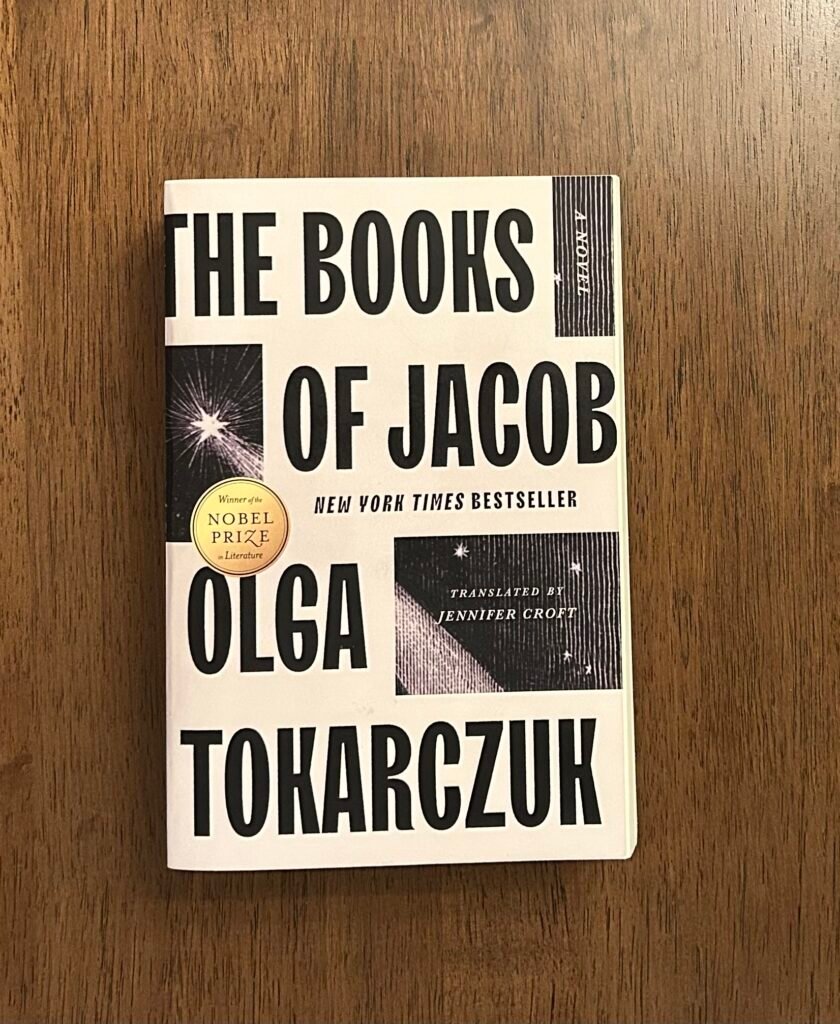
As I’m making my way through Olga Tokarczuk’s translated works I had assumes that BoJ would be the last considering that it falls close to 1,000 pages. But the mood struck in early May and I spent the past month reading this giant historical novel.
Books of Jacob centers around the Frankist movement following the 18th-century Polish messiah-claimant. While Jacob is the central figure, he remains distant in the novel which is told from the perspective of those around him–including followers, supporters, adversaries, and those occasionally overlapping with one or two of the previous groups.
We witness Jacob as a young scholar advocating for the use of the Zohar and against the Torah while gaining the support of a couple wealthy merchant families. He flees to the Ottoman empire due to clashes with the majority of the Jewish community. In exile, the followers begin practicing strange rituals and 1700’s polyamory (coordinated by Jacob).
Later, a plan is developed to have his entire movement baptized which gains him patronage and the possibility of return to Poland. The plans starts to unfold until Jacob is betrayed by one of his closest follows and becomes imprisoned (although bribes make this tolerable). When the monastery where he is held becomes captured, Jacob is released and moves to Offenbach where a supporter allows him use of a castle. As he grows into old age, he continues his teachings but raises a militia and lives extravagantly at the expense of his supporters. The movement begins to shrink at this stage and barely continues after Jacob’s death, but threads of the movement were dispersed through high spheres across Europe.
Like most of Tokarczuk’s writing, there are many plot lines occurring simultaneously which never fully come together (many being related only in location and not in time), time is somewhat warped, there are slightly misfit mystics, there is obsession, people maybe have too much time on their hands. This style makes for a challenging read at this scale and I’m not sure that I found it as engaging as her shorter works. A lot of time is spent hovering and in 3rd person to limited 1st person but things are relatively stagnant most of the time as the followers wait for the next step in their journey. There is a fable-like feel across the novel that, while appropriate, maintains some distance.
This might be one that I respect for its ambition and research more than I enjoyed
Leave a Reply