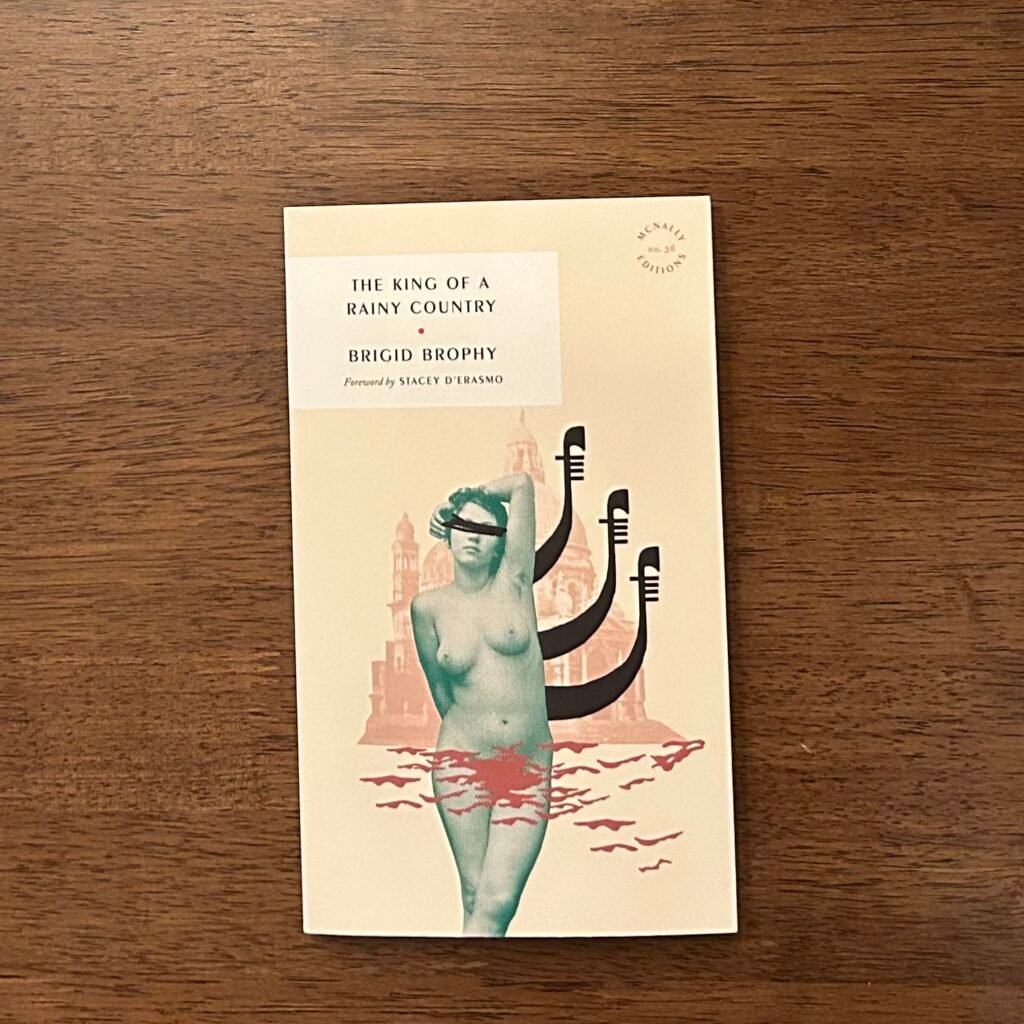
I tend to pick up any of the McNally Editions that seem mildly interesting and I figured I’d give this one a go at the end of April when it was a bit rainy.
“The King of a Rainy Country” follows Susan and Neale who are platonic partners trying to figure out if they can be attracted to each other despite their common homosexuality (this was first published in 1956). Susan takes a job at a bookstore only to find out it sells erotic books. Looking through one of them, she sees a photo of her school crush, Cynthia, who she had a complicated almost relationship with but never got closure. Trying to find her in London, she realizes that Cynthia is trying to become an actress in Venice. Susan and Neale drop everything and go to Venice as last minute tour guides to fund the trip. IN Venice they find Cynthia and meet a few other characters that provide some changes to their relationship.
The real appeal of this novel is Brophy’s writing which has a certain command while seeming casual as if she were telling the story and meandering between topics and times. Very few writers can make this work without things becoming confusing but Brophy succeeds. That being said, this novel didn’t really grab me in any way–it was fine.
As a side note, this novel has alot of French ands a fair amount of Italian which makes it difficult to follow without some background knowledge.
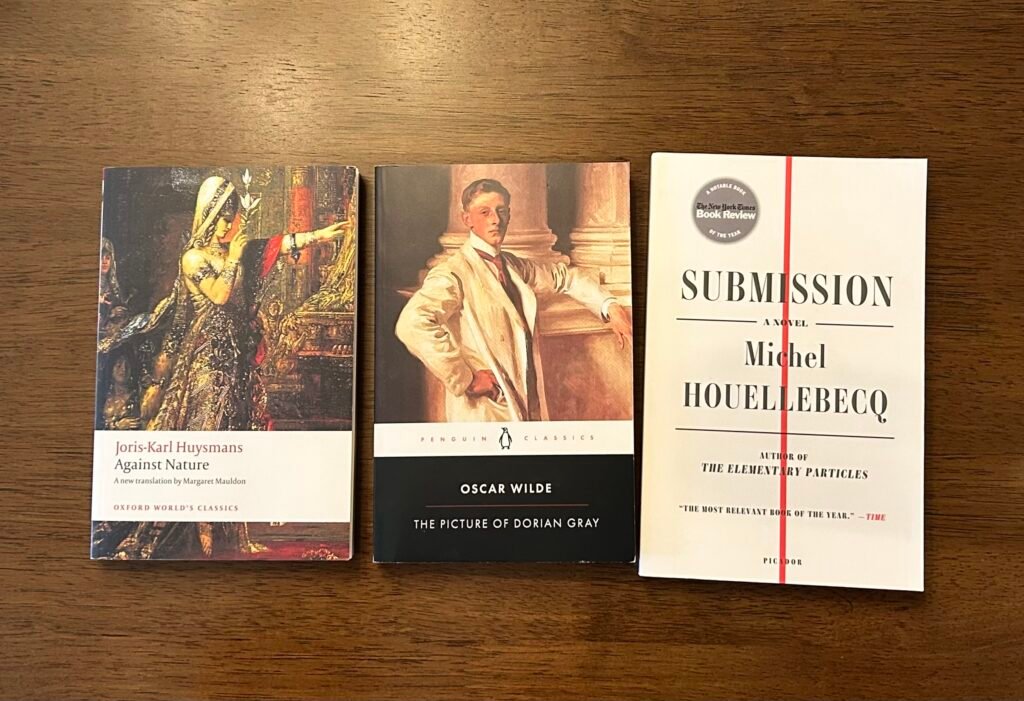
I have, for maybe ten years, wanted to read Huysmans’ “Against Nature” (À Rebours) since seeing it mentioned as a footnote of “The Picture of Dorian Gray.” This is considered to be the poisonous French novel that captivated Dorian and it clearly influenced Wilde’s writing, which seems quite clear.
Huysmans writes of an ailing heir, Des Esseintes, at the biological end of the family tree that was too interconnected. Years of hedonistic living and escorts have left him in poor health so he resolves to move into the country to live a solitary life of intellectual beauty. Chapters here serve mostly to display Des Essientes’s cultured tastes on such topics as Roman literature, interior decoration, jewels, plainchant, liqueurs, painting (including the Moreau on the cover), and perfume. These fixations exist in contrast to what Des Essiente feels is cultural decline where nothing of substance in being produced and the world is becoming fixated with industrial modernism (American, nonetheless). Unfortunately, the high arts offer no escape from Man’s necessarily social being.
This exists in the French tradition of brilliant novels that are terrible to read. This is tedious, with most of the interest happening in the introduction and at the end (maybe that’s the point). Huysmans posits that living through the senses is no replacement for living as social beings, even if that’s generally unpleasant.
I re-read Dorian Gray after the Huysmans since it had been a while. For some reason I thought that this novel was clunkier than it actually is and was pleasantly surprised at how much I still enjoyed it (maybe a little more at being able to recognize the Huysmans references).
Houellebecq writes of a Huysmans scholar (with plenty of references to À Rebours) working and existing as France elects an Islamic government through a compromise with the Left. Our protagonist, the nearly nameless François, a lonely professor disengaged from the world and mostly fixated on wine, cigarettes, and younger women (a Houellebecq novel, after all) is trying to avoid any issues while in the autumn of his intellectual life but must contend with the new government wanting to control higher education, putting him out of a job unless he converts.
Like Huysmans, Houellebecq writes a work of cultural pessimism about a life that is chiefly composed of materialism and bureaucracy, with a few carnal delights mixed in to make life bearable. Despite being considered a luminary on the Decadent period, François mostly craves connection and some higher sense of meaning in a culture that no longer emphasizes such things beyond a personal brand. His chief conflict is between his general dislike of organized religion and his desire to age with a partner (even through an arranged marriage). Largely a cultural critique of a modern Europe that has nothing to stand for and would be unable to resist a modern equivalent Ottoman invasion.
A bit of a tired rehashing of Houellebecq’s previous writing, a sub-par Houellebecq is still alright.
Finishing off a bag of bread flour and using whole wheat for the rest (~70%). This is more whole wheat than I usually like dealing with but the dough was alright and the loaf feels pretty good–
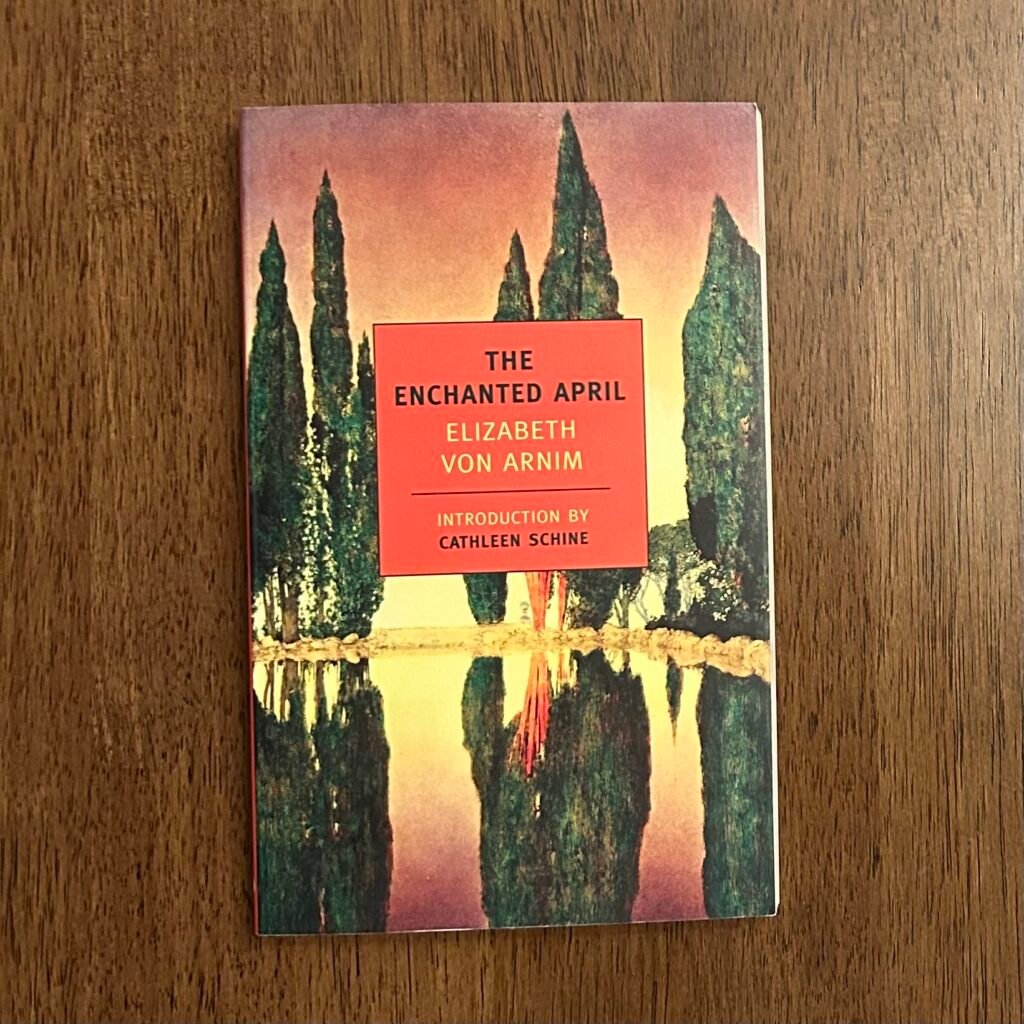
In the same category as “A Room with a View”–some stuffy English ladies go to Italy on vacation but end up dropping their formality in the lush, blooming gardens and find love.
Here, four ladies of different ages and means (but essentially all strangers) pool their money to rent a Tuscan villa for a month. Nearly nothing is coordinated ahead of time which leads to lengthy conflict over personal spaces and shared costs. Two of the women are particularly thorny: Lady Caroline just wants to be left alone and treated normally and Mrs Fisher just wants it to be the Victorian era again. Lotty holds things together with her enthusiasm while she and Rose worry about their unhappy marriages. The arrival of men, after much foreboding, shakes up the entire situation.
This is a lighthearted, happy-ending story with low stakes drama. The writing is old fashioned in a good way as the book takes its time and doesn’t try to force anything. Not the greatest thing ever written, but a nice spring read while everything was blooming.
After buying more whole wheat flour instead of bread flour I’ll be switching to a 50% whole wheat loaf for a while (or at least until I slow down on baking in May/June).
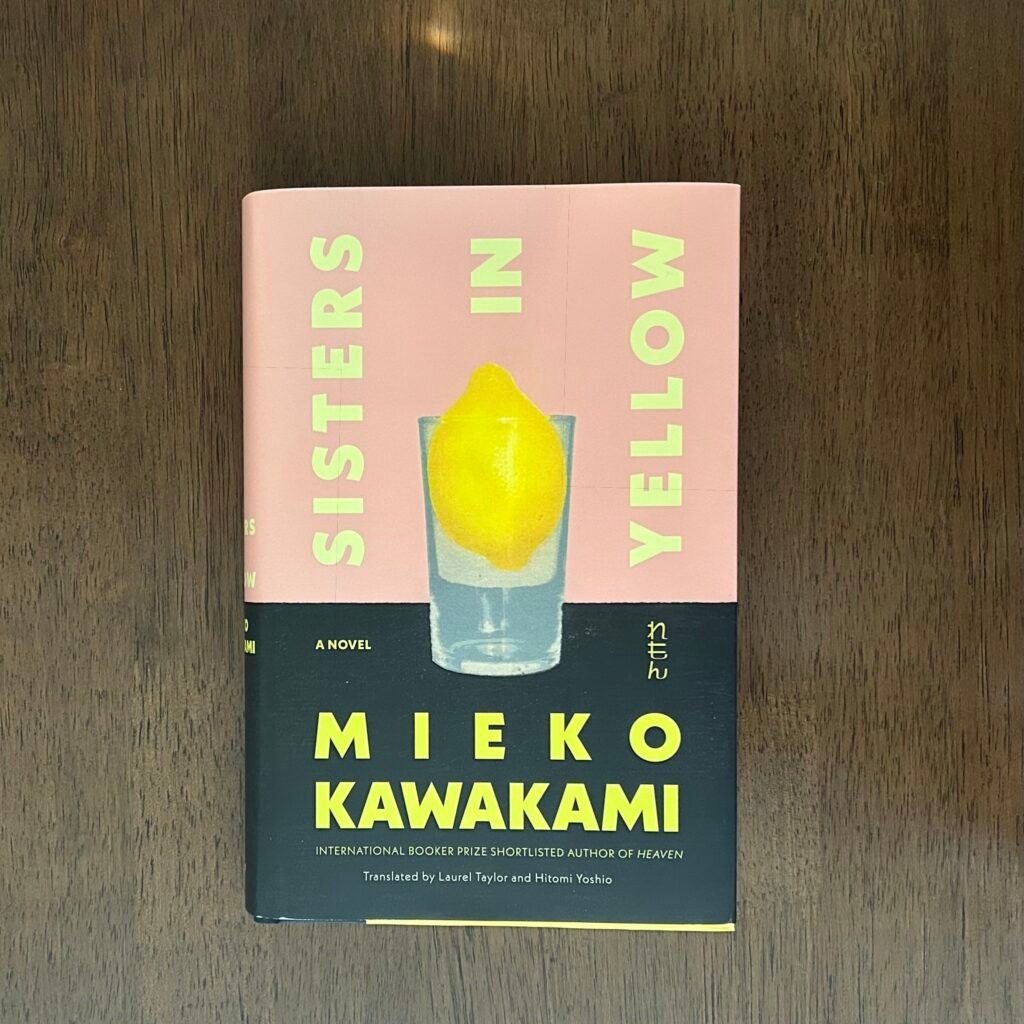
Mieko Kawakami has a style–a lonely, working woman struggles to stay afloat amid financial pressures and expectations about appearance/behavior/marriage/etc. Most of the books (“Heaven” is the outlier) have a consuming (but unreliable?) narrator. There’s an honesty about poverty and expectations in modern(ish) Japan like Tsushima but otherwise Kawakami nearly stands on her own. Maybe too much? It could be that there is a cultural barrier here but many of the topics and conversations felt a bit expected. Maybe this is a western lens applied to a work that is trying to make a point about the tenuous nature of the hospitality industry and how much appearance and tolerance of harassment are necessary to secure a small income. Maybe this point was already made in “Breasts and Eggs.” Our protagonist is lonely and motivated by the determination to work hard to the point of exhaustion due to a tenuous employment while neglecting any sort of leisure or social life, similar to “All the Lovers in the Night.”
This novel follows Hana, basically a runaway who takes a job at a bar and moves in with one of her mother’s strange friend, Kimiko, who had helped her when she was younger. She finds some friends who join her. When that’s no longer viable, she turns to petty crime and some Yakuza-associated schemes to get by. Things fall apart as always and a regular job is necessary which takes us to 2020.
Kawakami writes with style and control, this feels like her most mature novel but, having read the others, I wonder if she’s searching for more to say.
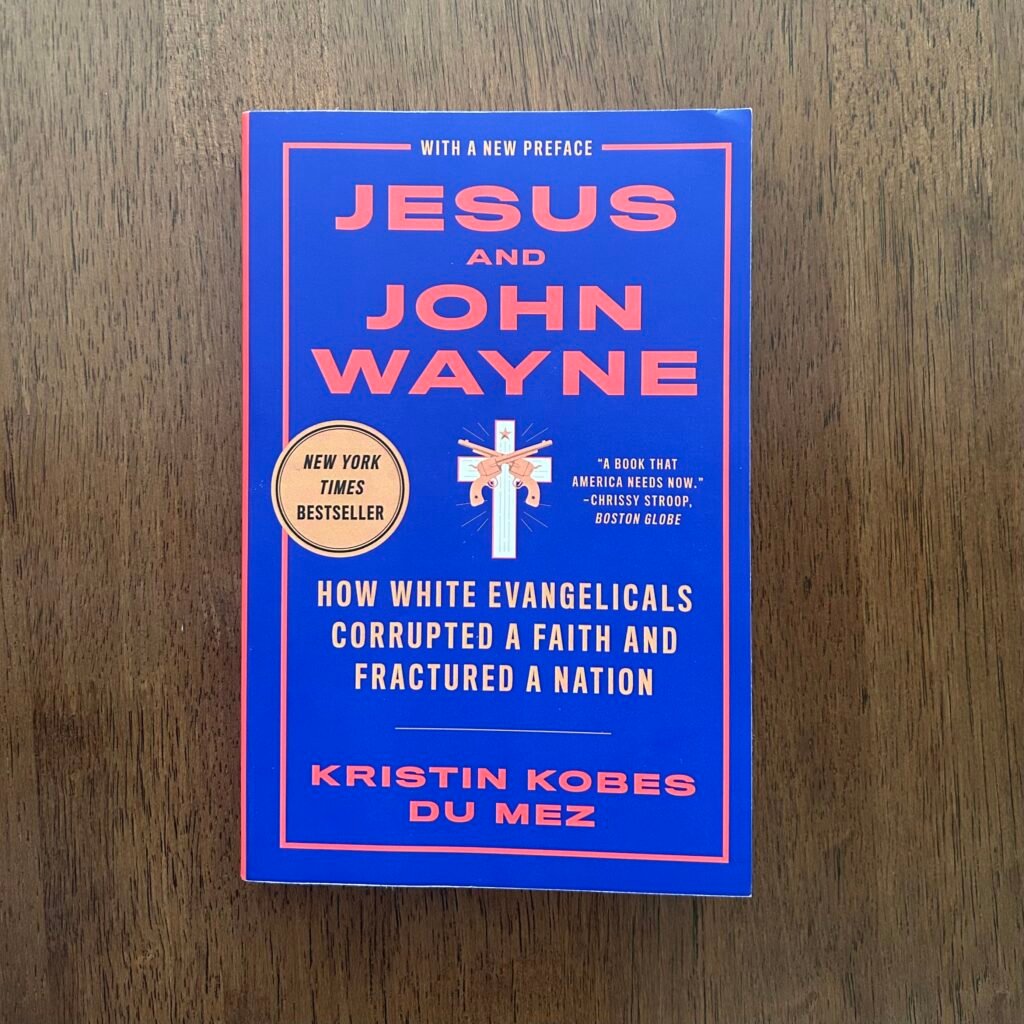
Du Mez writes a history of how Evangelical Christianity has interfaced with politics and become obsessed with (non-Biblical) displays of masculinity.
This book presents the Evangelical movement, particularly as it developed from the 1980s as more of a cultural movement linked to certain media consumption as the defining feature of the “Evangelical” voting demographic to explain how a religion-affiliated political movement came to define American Christianity. Largely, Du Mez is focused on voting patterns that claim to be religious but focus on gender roles and conservative politics above all else.
The book looks at a few major movements: Evangelicalism from the 1920s through the 1960’s (finding John Wayne), the Cold War (Oliver North), and the war on terror through the modern era (“spritiaul warriors” and sex scandals galore). The main takeaway is the extended long-game that’s been played between conservative Evangelicals despite different movements rising to power across the decades. When there isn’t a war, the movement has been concerned with gender and whether American men are masculine enough.
A historical argument is being made which leads to some one-sided exploration of how focusing on traditional gender roles led to scandals over predatory pastors which should be a consideration when reading this; this isn’t meant to be a non-thesis look at the Evangelical movement.
If anything is seriously missing from this work it’s higher education. The Falwell’s certain make their appearances, as does homeschooling, but there is little to be said about the rise of institutions like Liberty University and the many loosely accredited Christian colleges.
Listen: “Jesus and John Wayne” (googly eyes, Joy Oladokun, August Ponthier), “Jesus and John Wayne” (Gaither Vocal Band)